the virgin tax: why recycled plastic is harder than it looks
Everyone wants more recycled content, few want to pay for it, and the compounders asked to make it work have the least margin to spare.
- DATE
- AUTHOR
- READ
Recycled content is far easier to put in a sustainability report than into an extruder. Everyone in the plastics value chain wants more of it, few want to pay for it, and the people asked to actually make it work are the ones with the least margin to spare.
This piece looks at why: demand for recyclate is being pushed up hard, while the cost of making it is being pushed around by forces no compounder controls.
margins were already thin
A compounder's three biggest costs are raw materials, labour and energy. None of them has been kind lately.
- Energy. UK non-domestic electricity rose from 14.8p to a peak of 28.4p per kWh between early 2021 and late 2023, and was still about 75% above its starting level at the end of 2024. Gas more than doubled. UK industrial electricity sits around 46% above the IEA median (ONS).
- Labour. 36% of manufacturing vacancies are hard to fill, against 24% across the economy, and roughly one manufacturer in ten takes more than a year to fill a role (Make UK).
- Raw materials. Less a steady climb than a rollercoaster. In Q2 2026 alone, HDPE rose 38% and LDPE 31% as the Strait of Hormuz closure rattled supply (Flexible Packaging Europe, via ESM). Volatility is its own cost when you are quoting fixed prices to customers.
demand is coming
Brands like to tell consumers about the turtle-friendliness of their packaging, and regulators are steadily making it compulsory:
- EU: the Packaging and Packaging Waste Regulation sets minimum recycled content of 10–35% by 2030 and 25–65% by 2040, depending on polymer and application (TOMRA).
- UK tax: the Plastic Packaging Tax charges £228.82 per tonne on packaging with less than 30% recycled content from April 2026 (Rödl & Partner).
- UK EPR: packaging producers' fees are being adjusted for recyclability from 2026 (BRC).
- UK deposit return: a scheme for drinks containers is due to launch in October 2027 (Packaging Europe).
The direction of travel is clear. The timing is less so: the deposit return scheme charges producers nothing until the end of 2028, and some EU buyers expect to pay fines rather than comply (S&P Global).
Either way, each link in the chain passes the requirement down to the next. It lands with the compounders, whose job is to turn a bag of mixed recyclate into rheologically reliable pellets, batch after batch, at a price someone will pay.
why recyclate is hard
Against that demand sit three cost headwinds, and they compound (forgive the pun).
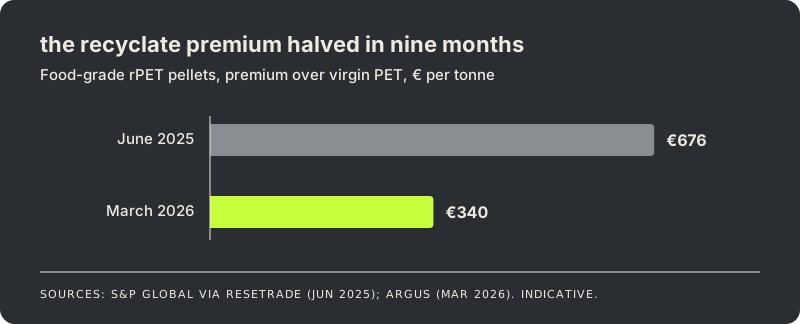
- Volatile prices. Comparing like with like, food-grade recycled PET pellets carried a premium of about €676 per tonne over virgin PET in June 2025 (S&P Global, via Resetrade). By March 2026, with the Strait of Hormuz closure pushing virgin prices up, that premium had narrowed to €340, and recycled PET flake was briefly cheaper than virgin for the first time in two years (Argus). Lower grades swung further: by April, Argus reported the widest discount of recyclate to virgin since its series began (Argus). The figures come from different price assessors, so treat them as indicative, but the point stands: when oil moves, the economics of recyclate move with it.
- Expensive energy. UK recyclers pay UK energy prices, and UK industrial electricity sits around 46% above the IEA median (ONS). They compete with virgin polymer and imported recyclate made where energy is cheaper. Cheap imports are the main reason Plastics Recyclers Europe gives for the loss of nearly a million tonnes of European recycling capacity since 2023, with the UK among the worst affected (Plastics Recyclers Europe).
- Unpredictable material. Recyclate from different sources varies in melt flow index, which makes processing inconsistent and scrap more likely (Queen's University Belfast). Every swing needs an experienced operator to notice and correct it, and those are exactly the people manufacturers cannot hire. Nor is it always what it says on the bag: the European Commission has warned that imports are "often virgin plastics wrongly claimed to be recycled" (Circular Online). Recycling, it turns out, is sometimes more (or indeed less) than meets the eye.
the virgin tax
Whether to buy recyclate or simply pay the tax is a decision that flips with the oil price. To avoid the UK Plastic Packaging Tax, a tonne of packaging needs only 30% recycled content, so the extra material cost is 30% of the recyclate premium. Taking food-grade PET:
- June 2025: 30% of a €676 premium is about €200 per tonne of packaging, somewhat below the £229 tax at recent exchange rates. Add the hidden costs (more scrap, slower runs, more operator attention) and the two are close enough that paying the tax is a defensible choice.
- March 2026: 30% of a €340 premium is about €100. Complying is clearly cheaper.
The trouble is not which answer is right, but that the answer changes faster than a compounder can renegotiate a contract or requalify a recipe. A business cannot plan around a calculation that depends on the Strait of Hormuz.
A caveat: the tax falls on packaging manufacturers and importers, not compounders directly. But compounders feel it through what their customers will pay for recycled-content pellets.
what would actually help
So: good demand drivers, strong cost headwinds. A compounder cannot control the oil price, energy tariffs or the pace of regulation. What it can control is the cost of turning a tonne of recyclate into good pellets: energy per kilo, scrap rate and operator time.
That is where efficiency gains count double. Every pound saved in conversion makes recyclate competitive on more days of the year, and makes the business less exposed when the spread swings against it.
If a line can measure how a batch of recyclate is behaving and adjust in real time, scrap falls, runs stabilise and one skilled operator can supervise more than one line. Researchers have shown this works on a single extruder in controlled conditions. The hard part is doing it on the machines compounders actually own, many of which predate the idea of a data connection.
That is the problem we are working on at Krayo. We would rather the virgin tax became the expensive option, whatever the oil price is doing.
put a number on it for your plant
A thirty minute consultation. We look at your lines, your inputs and your cost base, and identify where the margin is.
book a consultation →