one meter, many lines: why energy per kilo is set at the extruder, not on the bill
Most compounders know their electricity bill to the penny and their kWh per kilo per line not at all. That gap is where a surprising share of energy margin hides.
- DATE
- AUTHOR
- READ
We have written elsewhere about what UK manufacturers pay per kWh. This post is about the other half of the sum: how many kWh each kilo of compound actually takes, on which line, for which product. Price is set in the market. Consumption is set on the shop floor, and it is the half a compounder can do something about.
The awkward part is that most plants cannot answer the question. They know the site total from the supply meter and the tonnes shipped, and they divide one by the other. That number is useful for the board pack and not much else.
what specific energy consumption is, and why averages mislead
Specific energy consumption (SEC) is "the number of kwh used to process 1 kg or lb of material" (Robin Kent, Tangram Technology, in Plastics Technology). Kent puts the process load of a typical extrusion plant "in the region of 0.4 to 0.6 kwh/kg" (Plastics Technology). On top of that sits a base load, the fixed overhead "consumed even if no production is taking place", which he says should lie between 10% and 40% of the average total.
For the extruder drive alone, figures are lower. A review in Renewable and Sustainable Energy Reviews cites a recommended motor SEC of "0.0822 to 0.1644 kW.hr/kg" (Abeykoon, McMillan and Nguyen, 2021). A worked twin-screw example from equipment engineers lands at 0.154 kW per kg/hr, with a product that "always runs with a SE of around .25" used as an illustration (PlasticsToday).
These are indicative, not targets. Filled, reinforced and recycled grades behave very differently, and Kent himself warns: "Never try to apply an 'average' SEC for a plastics-forming process to your site" (Plastics Engineering). The useful comparison is a line against its own history, product by product.
where the energy goes
On a compounding line the main consumers are familiar:
- Drive and gearbox. Mechanical energy into the melt, plus losses on the way.
- Barrel and die heating. The review notes that "at low screw speeds, barrel heaters consume a considerably higher portion of energy than at higher speeds" (Abeykoon et al.).
- Cooling. Kent notes that cooling's share "is normally higher in extrusion lines" (Plastics Technology).
- Ancillaries and idling. Dryers, chillers, compressed air and pelletisers, many of which keep running between campaigns.
Idling is the least glamorous and often the most expensive item. The BPF notes that idling machines "are not free" and can cost "up to 90% of the full running costs" (BPF). An older government good practice guide, written with the BPF, cites a case where "about 20% of total energy was being wasted running idle equipment", and an extrusion audit in which "the non-productive energy use was about 50% of the total" (GPG 292, 1999). The figures are dated; the physics has not changed much.
running below rate is expensive
Because part of the load is fixed, SEC falls as output rises. "Increasing the production volume will automatically reduce the SEC," as Kent puts it, and "the lower the production volume, the greater the influence of the base load" (Plastics Technology). The BPF makes the same point: "increasing the production rate of most plastics machinery decreases the kWh/kg" (BPF). GPG 292 is blunter: a machine "throttled down to low production compared to capacity is inherently inefficient".
So why do lines run slow? Often for good reason. Abeykoon and colleagues note that "industrial extruders are typically operated at lower speeds in order to avoid undesirable fluctuations", and that as speed rises "the thermal quality deteriorates while the energy efficiency improves". That trade-off between kilos, kWh and quality is real. It is also usually settled by habit and a cautious recipe sheet rather than by data.
To give a sense of scale (an illustration, not a benchmark): a line producing 1,000 kg/h that runs 0.05 kWh/kg above where it could be wastes 50 kWh every hour. Over 6,000 hours that is 300 MWh a year, on one line, before anyone has argued about tariffs.
few plants can see it per line
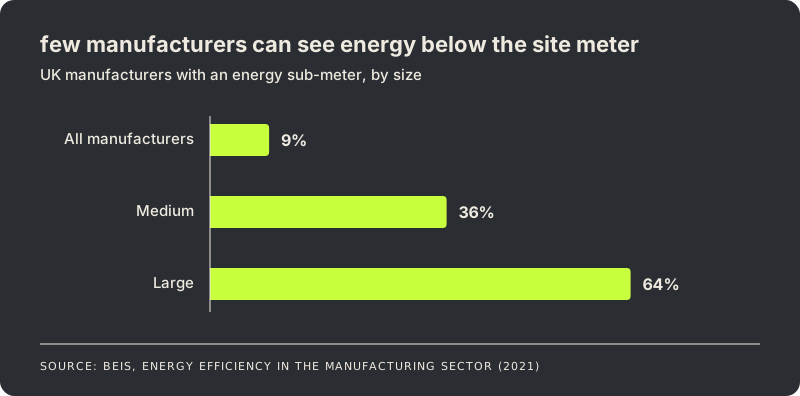
The data gap is wide. In a government survey of UK manufacturers, "only 9% of manufacturers have an energy sub-meter", rising to 36% of medium-sized firms and 64% of large ones; only 11% monitored both energy usage and energy efficiency (BEIS, Energy Efficiency in the Manufacturing Sector 2021). A sub-meter of any kind is a low bar; one per line, tied to product and recipe, is a much higher one.
The plastics-specific literature tells the same story. GPG 292's first case study is a processor whose only electricity meter was the supply meter. Kent argues that "direct sub-metering of the individual processes is much easier and more direct" than inferring from the site bill (Plastics Technology). An EU-funded survey run with the BPF found "66% of companies had not yet implemented an energy efficiency programme", though that was in 2010 (BPF, ENERGYWISE Plastics).
On regulation, some restraint is in order. Plastics are not in the EU's Carbon Border Adjustment Mechanism; the regulation only asks the Commission to assess extension, "in particular organic chemicals and polymers" (European Parliament Legislative Observatory). The first Ecodesign (ESPR) working plan prioritises textiles, furniture, mattresses, tyres, steel and aluminium, not plastics, though the Commission is to study the sector for future acts (ECOS). Per-product energy reporting is a direction of travel, not yet a legal obligation for most compounders. Whoever has the data when it arrives will find it a good deal less painful.
what we are working on
The case for line-level energy data is mostly a margin case. If you know kWh per kilo by line and by product, you can see which grades are quietly expensive, which recipes run slow for no reason anyone remembers, and how much idling costs between campaigns.
That is the problem Krayo is working on. Our software reads process data from the line, including drive load, zone temperatures and throughput, to:
- Measure energy per kilo per line and per product, from machine data rather than the site bill.
- Recommend setpoints that aim to hold quality while using less energy, with the operator deciding.
- Build product records from telemetry, so that if customers or regulators ask for energy per product, the answer already exists.
We have no results to report yet, and we would distrust anyone in this space who claimed them in advance. We would, however, like to talk to compounders who suspect their kWh per kilo is worse than it needs to be and would like to find out by how much.
put a number on it for your plant
A thirty minute consultation. We look at your lines, your inputs and your cost base, and identify where the margin is.
book a consultation →