the hour nobody invoices: why changeovers quietly set your cost per kilo
Shorter runs and more grades mean more purging, more transition scrap and more time spent dialling in. For high-mix compounders, the changeover deserves as much attention as the run.
- DATE
- AUTHOR
- READ
Ask a compounder where their margin goes and the answers are usually polymer prices and energy. Less often mentioned is the stretch of time between the last good pellet of one grade and the first good pellet of the next. Nobody invoices for it, it rarely has its own line in the management accounts, and it happens more often than it used to.
The trend is not new, but it has not reversed. As long ago as 2005, a Coperion executive told Plastics Today that some masterbatch customers faced "up to 15 cleaning and color changes per 24-hour period" (Plastics Today). By 2023, Compounding World's summary of the market was that "most compounders now run shorter production runs and are making more frequent product changeovers" (AMI). Smaller lots, more SKUs, same number of lines.
what a changeover actually costs
A grade or colour change has four cost components, and only the first tends to be measured with any care:
- Purge and transition material. Resin pushed through to clear the previous product, plus the off-spec material made while the new one settles. One US colour concentrate producer put it bluntly: "On a big line, on a 250-pound order you'll probably make 250 pounds of scrap" (Plastics Technology). An extreme case, but the arithmetic only worsens as orders shrink.
- Lost line time. Cleaning, screw pulls, screen changes and restarts. The same article describes changes "typically involving purging and complete screw pulls" (Plastics Technology).
- Time to stabilise. The line is running, but not yet making sellable product. Temperatures, pressures and torque are settling, and someone is adjusting setpoints until the colour, melt flow or dispersion comes into specification.
- Overproduction. A Farrel executive warned that compounders "need to produce quantities above order amount and then hope to sell it all" (Plastics Today), which is a polite way of describing stock that may never move.
The third is the least visible, because the line looks as though it is running.
the capacity you think you have
Nameplate throughput is a theoretical figure. Effective capacity is what remains after changeovers, and in high-mix work the gap can be large. A 2015 trade press report on colour compounding opened with the claim that "most extruders used for color compounding sit idle 60 percent of the time", attributing the problem largely to "lengthy screw-set and color change-over procedures" (Plastics Machinery & Manufacturing). The figure appears alongside an extruder maker's survey of ten of its own customers, so treat it as indicative of a segment rather than a benchmark. The direction is not controversial.
Some producers now plan around it explicitly. The colour compounder quoted above says its "goal is to never use more than 80% of our capacity on a regular base" (Plastics Technology), leaving headroom for the churn that small orders bring. Sensible, and also a fifth of the asset held partly in reserve for changeover friction.
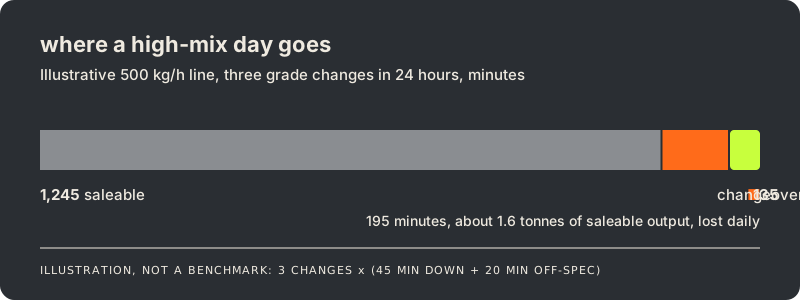
The cost per kilo consequence follows. Labour, depreciation, rent and much of the energy bill do not fall during a purge or a slow restart. Spread them over fewer saleable kilos and every kilo costs more. As an illustration only: a line nominally rated at 500 kg/h that loses 45 minutes to each of three changes a day, plus a further 20 minutes per change running off-spec, gives up more than three hours of saleable output daily before anything else goes wrong.
why the market makes this worse, not better
European compounders are not in a position to absorb waste comfortably. Plastics Europe data reported at K2025 show Europe's share of the global plastics market "collapsing from 22% in 2006 to just 12% last year" (European Rubber Journal). Recyclers have fared worse: Plastics Recyclers Europe expected closures by the end of 2025 to amount to "almost one million tonnes of recycling capacity since 2023" (Plastics Recyclers Europe), and in the UK the BPF reports that "around 260 K tonnes per year of recycling capacity has been lost due to site closures" against 1.1Mt of capacity in 2022 (BPF).
Recycled feedstock adds a further twist. AMI notes that compounders reprocessing post-consumer material face "unpredictable quality fluctuations and flow behaviour" (AMI). One colour measurement supplier goes further, arguing in its own white paper that for recycled substrates "formulas need to be redeveloped from scratch" (Datacolor). Each change, in other words, takes longer to settle.
the operator who knows
Where the dial-in is done by hand, the time to stabilise depends on who is on shift. The experienced operator knows that grade X needs zone 4 a few degrees warmer than the sheet says, and that the screw speed wants nudging after the first ten minutes. That knowledge is valuable, undocumented and goes home at the end of every shift. The same Datacolor paper observes that practitioners typically "learn through experience, often guided by a veteran colorist over many years", and that "as that generation retires, companies risk losing institutional knowledge that is difficult to replace quickly" (Datacolor). A vendor has an interest in saying so, but it rings true.
The result is variance: the same changeover takes different lengths of time on different shifts, and it is easy not to measure.
what we are working on
Faster mechanical changeovers are an equipment question, and machine makers have long worked on quick-change barrels and screw sets. The part that equipment does not address is the dial-in: getting from "running" to "in specification" quickly and consistently. That is the problem Krayo is built around.
The approach is unglamorous:
- Capture what good looks like per grade. Process data from the line already records the settings and conditions under which each grade ran well. Most of it is never revisited.
- Recommend setpoints during the transition. Rather than relying on memory, operators get suggested adjustments based on how previous runs of that grade, on that line, actually settled.
- Spread the best operator's judgement across shifts. The goal is not to replace experience but to stop it being a single point of failure.
- Work on the lines people actually have. Software that only works on a new line is of limited use to a plant whose extruders have decades of service left in them.
None of this is proven yet. But if a meaningful share of your changeover cost is time spent dialling in, it is worth measuring, and worth asking whether the answer is already sitting in your process data.
Krayo is building software to help compounders get there. If changeovers are eating your margin, we would be glad to compare notes.
put a number on it for your plant
A thirty minute consultation. We look at your lines, your inputs and your cost base, and identify where the margin is.
book a consultation →