the lab is always late: why MFI arrives after the margin has gone
Most compounders learn whether a batch was in spec after it has been made. The quality lag is not a lab problem; it is a margin problem, and process data can narrow it.
- DATE
- AUTHOR
- READ
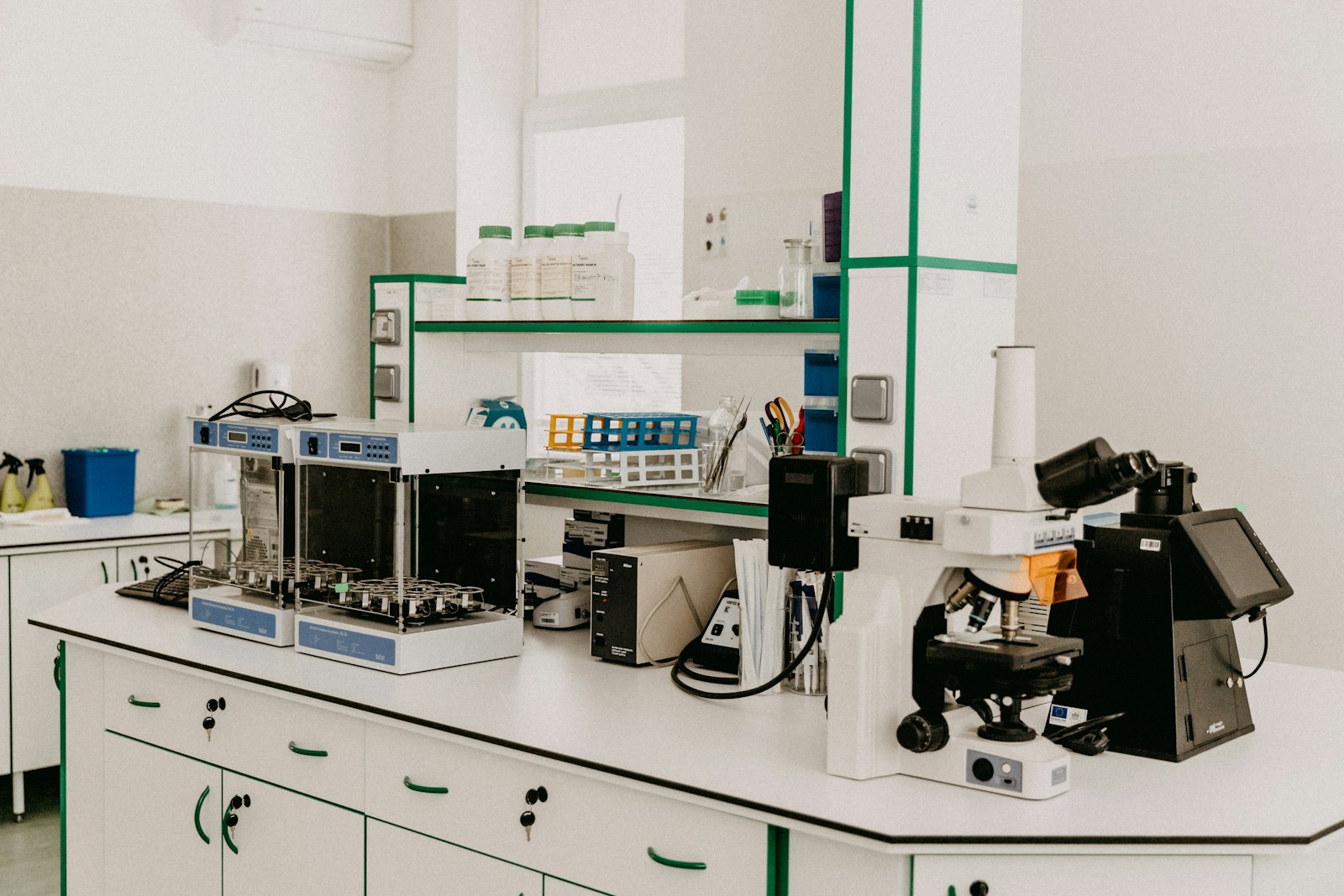
Ask a compounder how they know a batch is in spec and the answer usually involves a sample, a walk to the lab and a melt flow test. Ask when they know, and the answer becomes less comfortable. The line does not stop while the plastometer warms up. Whatever the extruder was doing when the sample was taken, it has carried on doing for some time since.
This is the quality lag: the gap between making material and finding out what you made. It rarely appears as a line item in the accounts. It shows up instead as regrade, rework, downgraded lots and the quiet habit of running a little safer than the specification requires.
what the lab test actually tells you
Melt flow rate is the workhorse. ASTM D1238 describes it as a test that "covers the determination of the rate of extrusion of molten thermoplastic resins using an extrusion plastometer", and notes that it is "particularly useful for quality control tests on thermoplastics" (ASTM International). The same standard is admirably candid about its limits. Melt flow rate "is not a fundamental polymer property" but "an empirically defined parameter", and the test conditions "will differ substantially from those in large-scale processes" (ASTM International).
None of that makes MFI useless; it is cheap and well understood. But it is a single, low-frequency number taken from a cooled sample, and it describes the past.
How far in the past? Tim Haake, general manager of rheometer maker Goettfert Inc., put it plainly in Plastics Technology: "a lab test requires someone to pull a sample, prep it, run it and report back, which could be 30 minutes to hours later" (Plastics Technology). He sells in-line instruments, so treat the framing accordingly, but the arithmetic of sample, prepare, test and report is familiar to anyone who has stood in a QC lab at 3am.
the cost of steering by a stale number
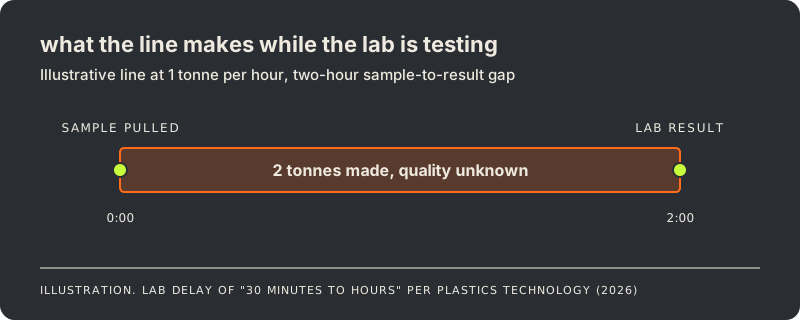
The consequence follows directly. In Haake's words, "by then, you may have made scrap for the entire intervening period" (Plastics Technology). To illustrate: a line running at one tonne an hour with a two-hour gap between sampling and result has two tonnes of material whose quality is, for practical purposes, unknown. If the result comes back out of spec, all of it is in question.
The cost of that gap tends to arrive in three ways:
- Direct loss. Out-of-spec lots are downgraded, reblended or scrapped, and the energy and labour that went into them are not refunded.
- Defensive margins. Operators who cannot see drift in real time sensibly aim for the middle of the window and overdose additives or masterbatch to stay there. That is rational, and it is paid for on every tonne.
- Slow correction. As Haake notes, "a lab result is inherently after-the-fact and can only inform a manual, delayed correction" (Plastics Technology).
Recyclers have it worse. AMI describes the need for "time-consuming testing offline" as "a major challenge for companies reprocessing post-consumer material with all its variability in quality" (AMI). Fraunhofer LBF makes a similar point about recyclate from "old material batches with highly variable quality" and "varying residual stabiliser content", and argues that "online rheological tests accelerate the process of achieving exact stabilisation and optimising costs" (Fraunhofer LBF). When the input varies batch to batch, a measurement that arrives an hour late is measuring a material you are no longer feeding.
in-line instruments help, with caveats
The obvious answer is to measure on the line. Dynisco, for example, offers an option that "allows users to automatically make real-time adjustments" to MFI against upper and lower control limits (Plastics Machinery & Manufacturing), and York-based Hydramotion markets an in-line melt-flow sensor aimed at recycled feedstock "where batches can vary widely" (Plastics Machinery & Manufacturing).
The academic literature is less enthusiastic about the hardware than the brochures. Researchers at Queen's University Belfast described the off-line laboratory capillary rheometer as "most accurate but involves significant time delay", while side-stream rheometers bring a "time delay of several minutes" and a side stream that "may not always represent the property of the bulk flow" (Liu et al., Polymer Engineering & Science, 2012). In-line rheometers, meanwhile, "can produce real-time measurements but disrupt melt flow and reduce throughput" (Plastics Today).
soft sensors: inferring quality from signals you already have
The alternative is to estimate quality from signals the extruder already produces: melt pressure, screw speed, barrel temperatures, motor load. This is the idea behind a soft sensor, and it has a respectable research history.
- An industry-academia study at an EVA plant in Edmonton built a melt index soft sensor using "variables from the plant extruder (pressure, speed and temperature)". Once installed, it "detects a change in the melt index nine (9) minutes before the online instrument" (Alleyne et al., ADCHEM 2006).
- More recently, University of Manchester researchers combined "physics-based knowledge with machine learning to predict melt viscosity in real time", reporting "a 95% improvement in terms of predictive performance" over earlier published work (Plastics Today).
Some sobriety is in order. The Belfast work, which used barrel temperature and screw speed as inputs (Liu et al., 2012), and the Manchester work were both done on single-screw extruders, and the Edmonton sensor sat on the pelletising extruder of a polymer plant, not a recycling line. Plastics Today also notes that the Manchester sensor "cannot detect viscosity changes due to changes in material properties" (Plastics Today), which is rather the problem a recycler faces. A model that works on a university extruder is a promising start, not a plant result. Soft sensors complement the lab; they do not replace it, and the lab remains the reference that keeps them honest.
what we are working on
The case for closing the quality lag is a margin case, not a technology one. If you can see a batch drifting from process data while it is being made, you can correct it while the correction is still cheap, and you can afford to run closer to the specification rather than safely inside it.
That is what Krayo is building: software that reads the signals a line already produces, often from older machines with nothing more modern than a PLC, infers how the material is likely behaving, and recommends setpoint adjustments to operators before the lab result arrives. The lab still has the final word. We would simply like it to have less bad news to deliver.
It is early, and we are not claiming results we do not have. If the quality lag costs you more than you would like, we would be glad to compare notes.
put a number on it for your plant
A thirty minute consultation. We look at your lines, your inputs and your cost base, and identify where the margin is.
book a consultation →