death by a thousand rpm: how wear and blocked screens quietly erode compounding margins
Breakdowns get the attention, but worn screws and loading screens cost compounders output long before anything stops. The signals are usually already on the line.
- DATE
- AUTHOR
- READ
Unplanned downtime is the cost every plant manager can name. The line stops, someone calls the maintenance contractor, and the lost hours appear in the monthly report. It is visible, and it tends to get a budget.
The more expensive problem in compounding is often the one that never triggers an alarm. A screw wears, a screen pack loads, and the line keeps running at a slightly lower rate, a slightly higher melt temperature and a slightly worse cost per tonne. Nobody records that as downtime. It shows up, if at all, as a margin that is a little thinner than the spreadsheet said it would be.
what a stoppage costs, according to the surveys
The headline downtime figures come mostly from large-company surveys. Siemens' True Cost of Downtime 2024 estimates that unplanned downtime now costs the world's 500 biggest companies 11% of their revenues, and that an average large plant loses 27 hours a month to it (Siemens, True Cost of Downtime 2024). It puts the cost of a lost hour at $2.3 million in a large automotive plant and $36,000 in fast-moving consumer goods. The survey is based on 181 interviews across automotive, FMCG, heavy industry and oil and gas. Compounding is not among them, and a 30-tonne-a-day compounder is not a car plant.
Closer to home, a 2025 study by Fluke with Censuswide, covering 600 senior manufacturing leaders in the UK, Germany and the US, found that 68% of UK manufacturers reported unplanned downtime, and put the cost to UK manufacturing at up to £982m per week (The Manufacturer). Fluke sells maintenance tools, which does not make the numbers wrong, but is worth bearing in mind.
Neither tells you your own cost per hour: contribution margin on the lost tonnes, plus restart scrap, plus whatever a late delivery does to the customer. That number is worth working out, because it justifies everything else.
wear: the slow leak nobody books
Screw and barrel wear is a well-understood problem with an unhelpful property: it arrives gradually. In a 2023 Plastics Technology article, Mark Spalding and Tim Womer note that "abrasive components in the resin can cause high wear rates", listing glass fibres, silica and calcium carbonate among the usual culprits (Plastics Technology). KraussMaffei, selling liners to deal with it, observes that more compounds are fibre-reinforced and some come with high shares of fillers and reclaimed material (Interplas Insights).
The economics are the interesting part. Spalding and Womer identify the main symptoms as a reduction in specific rate (output divided by screw speed) and higher discharge temperatures. For small losses, "the processor can just increase the screw speed to maintain output rate". That works until the melt runs too hot, at which point the rate has to come down. In their blown film example, holding melt temperature with a worn screw meant cutting the rate by about 13%.
Two points follow:
- The first symptom is often hidden by the operator. Turning up the screw speed is a sensible response on the shift. It also means the output figure looks fine while the machine is working harder for each kilogram.
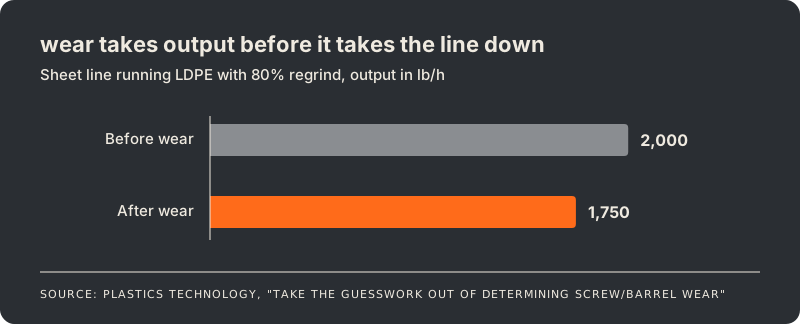
- The loss is not dramatic enough to escalate. A line that has drifted from 1,000 to 900 kg/h over a year does not get an incident report. A Plastics Technology piece describes a sheet processor running LDPE with 80% regrind whose output fell from about 2,000 lb/h to roughly 1,750 lb/h through wear (Plastics Technology).
It would be reasonable to expect energy per kilogram to drift upwards as well, since the motor is turning faster for the same output. We have not found good published data quantifying that for compounding lines, so treat it as a hypothesis worth checking on your own meters rather than a fact.
screens, recyclate and the pressure gauge
For recyclers, the screen changer is often where the day goes. As contaminants are retained, the free area of the screen shrinks and, as instrumentation maker ICS Schneider puts it, "the pressure can rise significantly over the filter service life" (ICS Schneider Messtechnik). They also point out that a cooler or more viscous melt can raise differential pressure across the same screen, which is why a single pressure reading on its own can mislead.
The scale of the problem with dirty feedstock can be striking. A Nordson Kreyenborg case study describes a European post-consumer PE recycler that moved from changing screens every eight minutes to once a day after replacing its screen changers (Plastemart). That is a vendor case study, and an extreme one. The broader point is that pressure before and after the screen is a continuous record of feedstock quality and filter condition.
older machines are not a reason to wait
Much of the UK's compounding capacity runs on machines that predate any notion of data connectivity. The Fluke study found that the most cited challenge among UK senior leaders was insufficient data or technology infrastructure, at 52%, and named "outdated assets" among the barriers to moving beyond reactive maintenance (The Manufacturer).
Machine builders increasingly offer dedicated sensors; EREMA launched one at K 2025 that uses ultrasonic sensors to detect screw and barrel wear in real time (Interplas Insights). Useful on new kit, less so on a 15-year-old line whose builder no longer exists. Yet even an old line usually reports motor load, screw speed, melt pressure and barrel temperatures somewhere, whether on the PLC or a panel display. Trended against throughput, those signals say a good deal about the machine's condition:
- Specific rate and motor load over time, adjusted for recipe, as a proxy for wear.
- Differential pressure across the screen, read alongside melt temperature, for filter loading and feedstock quality.
- Specific energy per kilogram, as a running check on whether the line is working harder for the same result.
None of this needs a new extruder. It needs someone, or something, to watch the numbers continuously and notice when they move.
where this leaves the margin
The case is less about avoiding catastrophic failure and more about the months before it: the slow loss of rate, the creeping melt temperature, the screen changes that come a little sooner each week. Those are margin, and they show up in signals most lines already produce.
That is the problem Krayo is working on: reading existing process data continuously, including from machines that were never designed to share it, to spot wear and drift before they become a rate cut or a stoppage. We do not have results to show yet, and we will say so when we do.
put a number on it for your plant
A thirty minute consultation. We look at your lines, your inputs and your cost base, and identify where the margin is.
book a consultation →